Aptos is a new, independent project to fulfill the vision of delivering the safest and most production-ready blockchain in the world.
The Aptos blockchain leverages the Move programming language.
Also it features the Move VM for application development, which are created and optimized for blockchain use cases.
The road to the Aptos mainnet
The road to the Aptos mainnet passes through a series of incentivized testnets.
During this journey, Aptos community comes together to build a secure, reliable, and decentralized network.
AIT comes in 4 phases:
IT1 (Incentivized Testnet 1) – Decentralized Startup
Goals:
- Performing decentralized network startup using GitHub / Genesis tooling
- Members Remain online and participate through the completion of the testnet as measured by Aptos
IT2: Staking
Goals:
- Validating that staking, rewards, and delegation work as expected
- Motivating validators to offer tokens via faucets to support distribution of test coins
- delegation to validators, and ecosystem engagement
IT3: Governance and upgrades
Goals:
- Performing a decentralized network upgrade via the on-chain governance
- Supporting new validators joining the network via backup and restore
IT4: Dynamic validator topology
Estimated start time: August 2022
Goals:
- Final warm-up before moving to Mainnet
- Validator DDoS validation
What is AIT in Aptos project?
It stands for “Aptos Incentivized Testnet”.
A testnet is an instance of a blockchain powered by the same or a newer version of the underlying software, to be used for testing.
What is the intent of Aptos testnet?
Testnet is designed to improve the operational experience, security, and design of the Aptos mainnet protocol and to expose potential issues and to improve participant experiences prior to the mainnet launch of the Aptos Protocol.
What is the Move language in Aptos?
Move is a new smart contract programming language with an emphasis on safety and flexibility.
The Aptos blockchain uses Move’s object model to represent its ledger state and uses
Move code (modules) to encode rules of state transitions.
How Aptos ensures a safe user experience?
As stated in their whitepaper, there are several innovations provided by the Aptos blockchain that work towards this goal:
- Transaction viability protection – the blockchain constrains the viability of every transaction and protects the signer from unbounded validity.
- Move-based key management – Aptos accounts support key rotation, an important feature that can help reduce the risks associated with private key compromise, long-range attacks, and future advances that might break existing cryptographic algorithms. In addition, Aptos accounts are also flexible enough to enable new hybrid models of custody
- Pre-signing transaction transparency – the ecosystem provides services for transaction pre-execution: a precautionary measure that describes to users (in human-readable form) the outcomes of their transactions prior to signing.
- Practical light client protocols – Aptos provides state proofs and light client verification protocols that can be used by wallets and clients to verify the validity of data being presented by an untrusted third-party server.
Collaboration with Google Cloud
Aptos Labs announced its collaboration with Google Cloud which will help companies and developers build more easily on the Aptos network.
Google Cloud will be one of Aptos’ inaugural cloud partners and will provide scalable, secure, and sustainable infrastructure. with Google colud developers within the Aptos network can build and scale their applications.
What makes Aptos a advanced blochchain?
- High performance
Aptos uses a Byzantine Fault Tolerant (BFT) consensus protocol which promises high performance.
From the original “Hotstuff” BFT consensus, Aptos Labs spent 3 years and 4 iterations building their BFT V4 engine.
With this, Aptos has the following capabilities:
- Zero downtime with a diverse set of operators.
- Sub-second finality of transactions.
- Immutability and Safety: The blockchain cannot be forked.
- Suited for Decentralization: The project singles out unresponsive validators
2. parallel execution
Aptos also has a special feature known as parallel execution. With this, Aptos can run multiple chains at the same time.
In comparison, today’s blockchains, such as Ethereum, use serial execution. Simply put, they can only process the next transaction once the previous one has been verified.
With AptosBFT V4 and parallel execution, Aptos can achieve high throughput.
- The Move language
Aptos uses a programming language called Move. In the past, Move was built specifically to develop Diem.
Today, it helps developers build Aptos.
Move’s programming language has several benefits. Which specifically are:
- Easy customization of digital assets.
- Secure storage of information.
- Easy resolution of bugs.
- Quick code verification and testing.
- Easy multi-chain development for applications.
Tokenomics
The Aptos Foundation presents a summary version of the Aptos protocol tokenomics below. A more comprehensive explanation of Aptos tokenomics and values is coming soon.
Initial Supply
Mainnet was launched on October 12, 2022. The initial total supply of Aptos tokens (APT) at mainnet was 1 billion tokens. APT will have 8 digits of precision as part of the fraction where the minimal unit is called an Octa.
| Category | % of Initial Token Distribution | Initial Tokens |
| Community | 51.02% | 510,217,359.767 |
| Core Contributors | 19.00% | 190,000,000.000 |
| Foundation | 16.50% | 165,000,000.000 |
| Investors | 13.48% | 134,782,640.233 |
read more about Aptos tokenomics here.
APTOS MAKES NO REPRESENTATION OR WARRANTY, EXPRESS OR IMPLIED, AS TO THE COMPLETENESS OR ACCURACY OF THIS PRESENTATION AND IT IS SUBJECT TO CHANGE WITHOUT NOTICE.
Aptos wallets
Petra Aptos Wallet is a crypto wallet for this blockchain.
Petra encrypts your keys and allow you to:
- Store, collect, and trade coins
- View and create NFTs
- Interact with dApps
- Import private keys and mnemonic
Martian Aptos Wallet is also a Aptos wallet.
with Martian wallet:
- Create and import wallets
- Deposit Test Coins and Transfer them
- View your NFTs in the wallet
- Build basic dApps on Aptos by integrating with Martian
- Mnemonic seed phrase is 100% encrypted
- Seed phrase is not stored by Martian in any server
Aptos price
Major exchanges have been fast to list the APT token. and As expected, token prices surged when they hit exchanges, according to CoinGecko.
However, in typical fashion and as predicted by market analysts, APT has already dumped almost 50% to $7.30 at the time of press.
FAQ
Aptos targets Q3 2022 for mainnet launch.
The devnet can mint millions of NFTs in under an hour, a significant step up compared to other solutions, while remaining completely decentralized.
Aptos made spinning up and minting millions of NFTs painless:
– highly efficient parallel execution engine dramatically speeds up our ability to mint NFTs: both creating and funding new accounts and then minting NFTs for them.
– Aptos terraform configuration enables anyone to quickly spin up testnets and clusters of validators.
– CLI allows to test the contract locally and then deploy it to the network seamlessly with confidence in its functionality.
– Aptos Typescript SDK lets us write a quick script that uses the faucet to create an account, fund it with test tokens, and then create and submit the transaction to mint the actual NFT.
The native Aptos token will be used for transaction and network fees, governance voting on protocol upgrades and on-chain/off-chain processes. also this token will be used for securing the blockchain via a proof-of-stake model. (staking reward potential)
The Aptos cryptocurrency not released yet.
There is no crypto exchange with which you can buy Aptos token.
The community members who participate in Aptos Incentivized Testnets will receive certain amount of tokens. more details here.
follow the Aptos twitter account for updates regarding token release: https://twitter.com/aptoslabs
Aptos Labs raised $200M led by a16z with participation from Multicoin Capital, Haun Ventures, ParaFi Capital, IRONGREY, Hashed, Variant, FTX, Paxos, Coinbase, and others.
Also in July 2022, Aptos Labs announced $150M funding round led by FTX Ventures and Jump Crypto, including new investments from Apollo, Griffin Gaming Partners, Franklin Templeton, Circle Ventures, Superscrypt founded by Temasek, and continued support from a16z crypto and Multicoin.
Mo (Mohammad) Shaikh.
He is a 3x founder and expert in going from 0-1 and scaling products.
He has been invited to speak at the World Economic Forum at Davos to discuss innovation across sectors. Shaikh has over a decade of depth in capital markets, private equity, venture capital across US, EU and Middle East markets.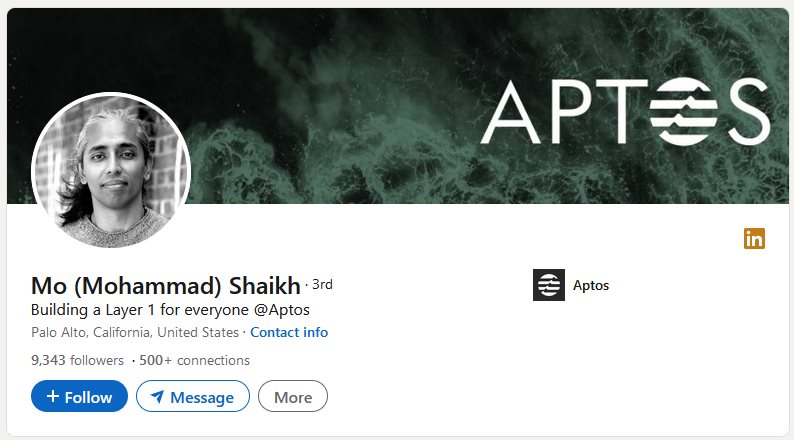
The Aptos blockchain will be owned, operated, and governed by a broad and diverse community.
Mohammad Shaikh in this post, invites everyone to provide input and join the Aptos community. Aptos community is looking for builders, validators, users, brands, creators, and believers.
The Aptos blockchain adopts an approximate, agreed-upon, physical timestamp for every proposed block, and correspondingly, all transactions within that block.
Where we can see the blocks and transactions? Currently there is an explorer here: explorer.devnet.aptos.dev
Sources:
aptoslabs.medium.com – aptos.dev – aptoslabs.com

 Shojaeddin Jahandideh